What is the argument in this sketch from Punch? What methods of characterization does the person find acceptable/unacceptable? What does the article's opinion (and satire) say about the status of "scientific" characterization in the late 1840s? Why would people want to use phrenology and physiognomy (and other assorted methods of character analysis)? Alternatively, what might people have against such strategies?
 According to The Satirist; Or the Censor of the Times, the Chartist folly quickly ended. What does the article represent as the greatest folly of the Chartists? Why? What type of person would hold such views about the Chartists? Do you think John Barton succumbs to such folly? Does Gaskell represent him and the other Chartists as foolish or naive in any way?
 This song appeared in John Bull in August 1839, the period in which Mary Barton is set. What type of language is being used? Who do you imagine wrote this piece, and to whom it was addressed? Can you imagine John Barton subscribing to the rhetoric used here? Think about the representation of Chartism in this poem as compared to its representation in Mary Barton.
 This article, which is rather long (and of which only one page is posted here), first appeared in Fraser's Magazine. What type of reader would be interested in this description of Lancashire cities? Is the representation of the poor sympathetic? Does it objectify the poor? What types of elements are emphasized in the description? Compare the language here to that in Mary Barton -- is it the same? Why or why not?
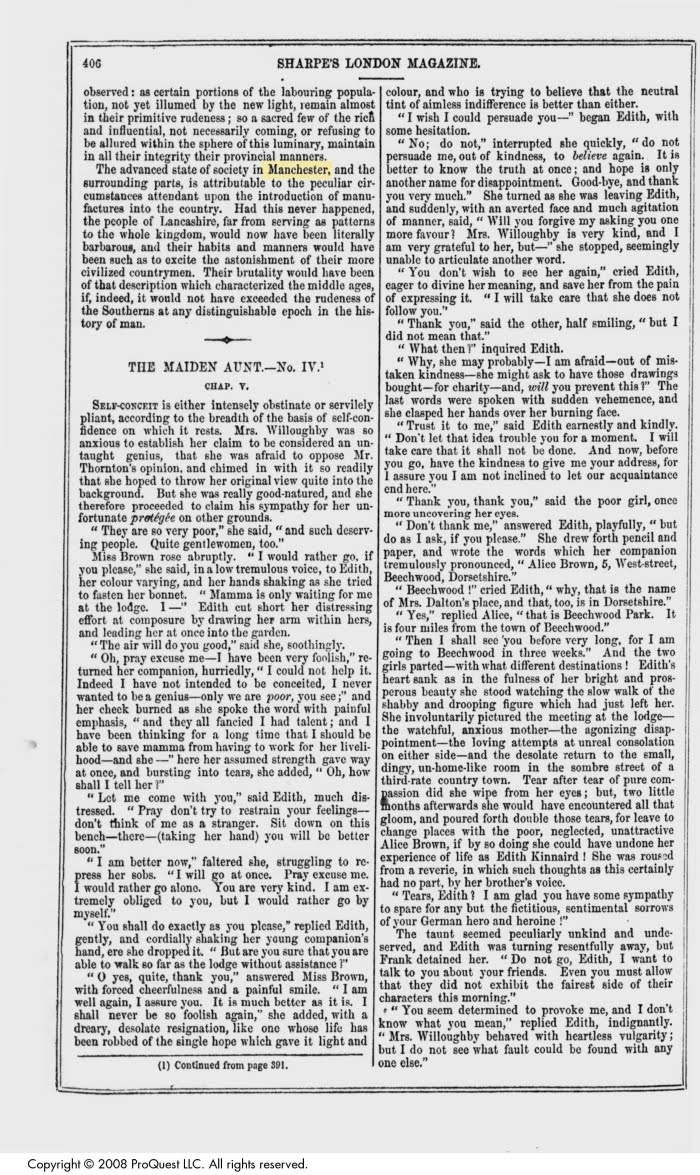
 This article, which appeared in Sharpe's London Magazine, offered to give a "slight sketch" of men and manners in Lancashire. Focus on the section that talks
  specifically about Manchester. What type of language is used to describe the city and its residents? How does the author address the question of industrialization and factory work? What is the split between barbarism and intellect, and who is characterized by each respective quality? Is this a class division or something altogether different?
 This poem is from Punch, a journal that we are accustomed to associate with satire. What, if anything, is being satirized here? The pauper himself? His attitudes toward Christmas (and what could, potentially, be seen as reckless spending on that day)? The society that has created the pauper and left him only one day for enjoyment? Does Dickens's portrayal of Bob Cratchit seem similar to that of the figure being represented in the poem?
 What is the argument made by this article? How does the author feel about Christmas and the way that it is practiced in the present (the piece was published in the London Pioneer on December 30, 1847)? Can we compare the sense of Christmas here to the scenes of Christmas that Scrooge sees in the company of the second spirit? Dickens's novella was published in December 1843 -- would readers have seen it as an "accurate" representation of Christmas at that time, or would they have imagined it to be back-dated (like Jane Eyre and Vanity Fair)? After reading this article, do you imagine a different reception for A Christmas Carol than you did before?